A Study in Memory
1.
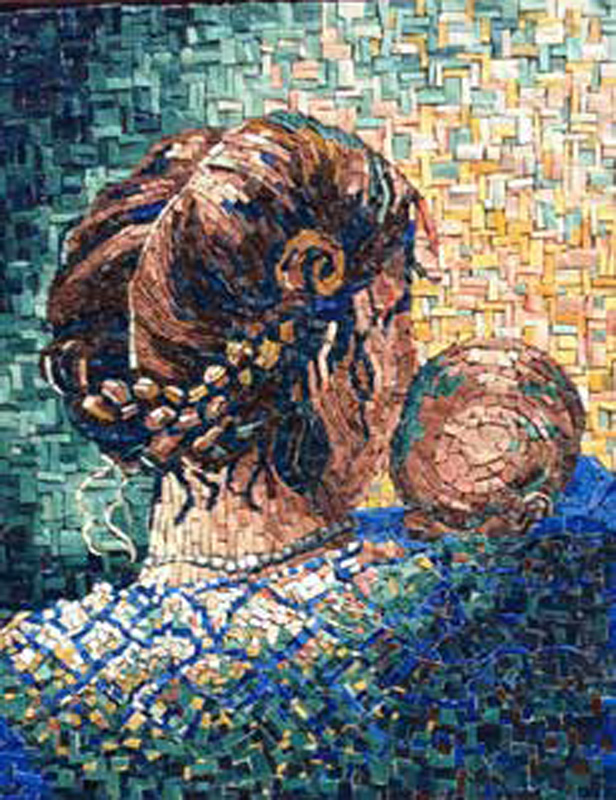
This mosaic is made in smalti, the coloured glass used for mosaics in Byzantine churches.
The history of its making is quite long. It started around 1500, in Genova, Italy. Around 1600 the Italian baroque painter Giovanni Paggi made a painting called 'Venere e Cupido che si baciano’ (Venus and Cupid kissing)
This mosaic is made in smalti, the coloured glass used for mosaics in Byzantine churches.
The history of its making is quite long. It started around 1500, in Genova, Italy. Around 1600 the Italian baroque painter Giovanni Paggi made a painting called 'Venere e Cupido che si baciano’ (Venus and Cupid kissing)
2.
I first saw this work in an exposition in the KMSKA (Antwerp) in 2004. It was hanging alone against a big wall covered with black velvet. Light was perfect. I fell in love with this painting because of its composition (the back of Venus)--the braided hair, the pearls and the beautiful light. There and then I decided I wanted to paint something similar. At the time, I did not buy the catalogue of the exposition.
Instead I stored the image in my head, or at least I thought I had it stored.
I first saw this work in an exposition in the KMSKA (Antwerp) in 2004. It was hanging alone against a big wall covered with black velvet. Light was perfect. I fell in love with this painting because of its composition (the back of Venus)--the braided hair, the pearls and the beautiful light. There and then I decided I wanted to paint something similar. At the time, I did not buy the catalogue of the exposition.
Instead I stored the image in my head, or at least I thought I had it stored.
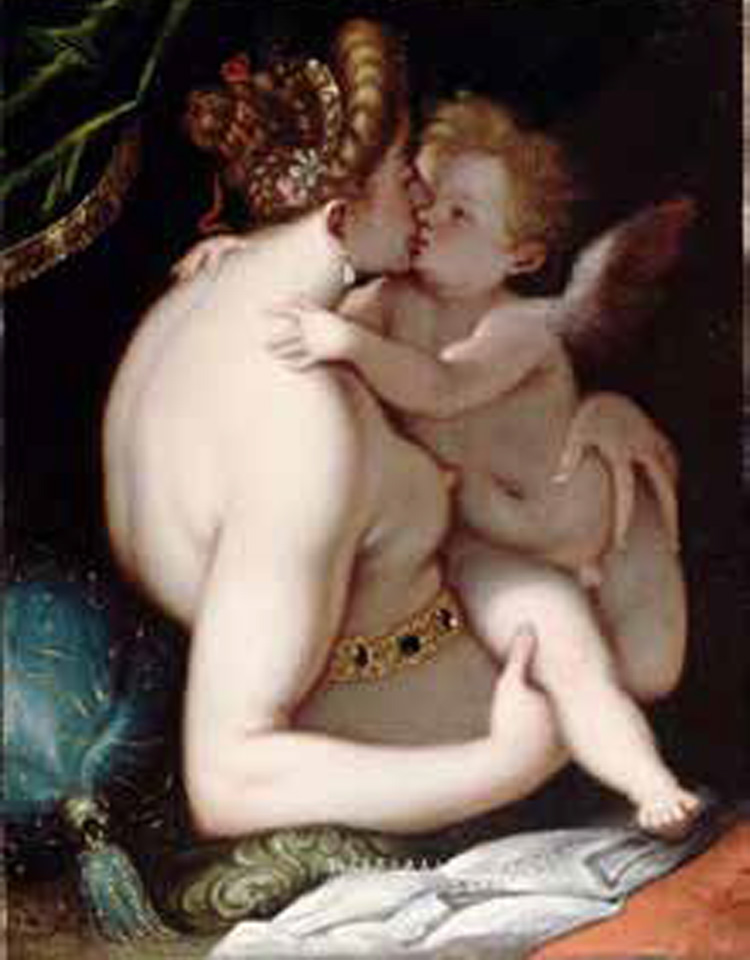
Title: Venus and Cupid kissing
Artist Giovanni Battista Paggi (1554-1627)
Date: 16th-17th century.
Technique: Oil on canvas
Artist Giovanni Battista Paggi (1554-1627)
Date: 16th-17th century.
Technique: Oil on canvas
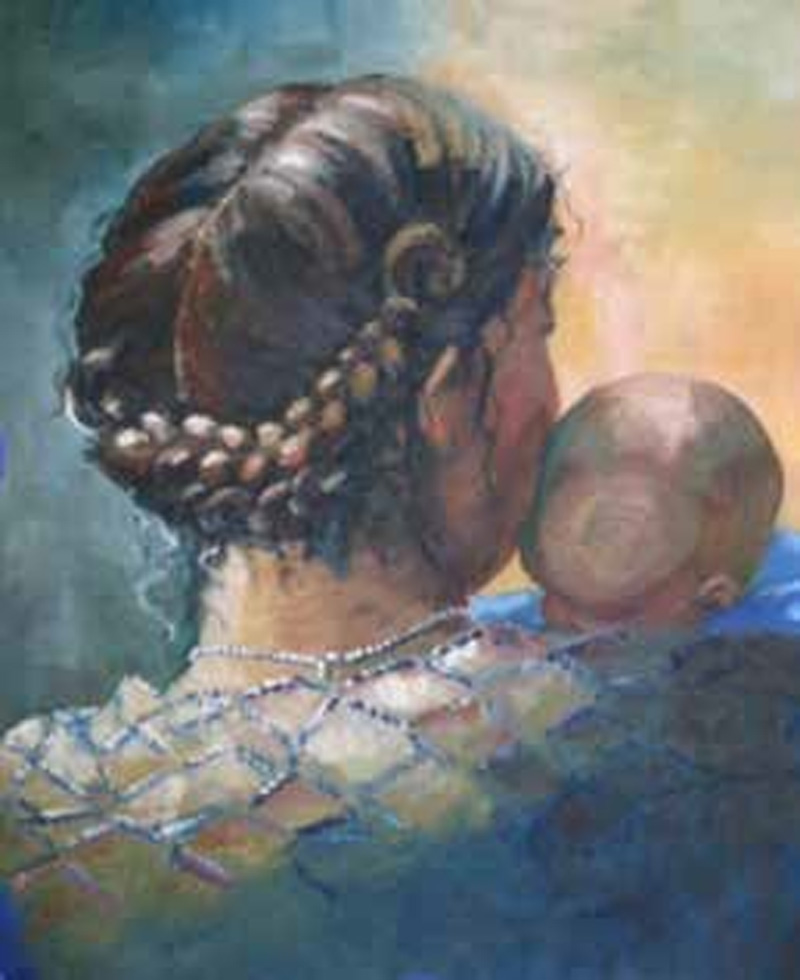
Mother and Child by Greet Tijskens
3.
Some years later, a friend with very long hair had a baby. She generously agreed to be my model. She posed 3 times. When it was almost finished, I bought the catalogue but I could not find the painting that took my breath away. By eliminating all the works that had no mother and child, I eventually identified the painting. It was very different than in my memory. The hair definitely was not the subject of the painting, it was not a view of her back. Only the light reflections were there. I felt betrayed by my memory, but happy I started the painting of my friend as I remembered it, not as it was.
The painting was 80 x 100 cms, oil on canvas. Later on I used the painting to make a mosaic in smalti, 40 x 50 cms.
Some years later, a friend with very long hair had a baby. She generously agreed to be my model. She posed 3 times. When it was almost finished, I bought the catalogue but I could not find the painting that took my breath away. By eliminating all the works that had no mother and child, I eventually identified the painting. It was very different than in my memory. The hair definitely was not the subject of the painting, it was not a view of her back. Only the light reflections were there. I felt betrayed by my memory, but happy I started the painting of my friend as I remembered it, not as it was.
The painting was 80 x 100 cms, oil on canvas. Later on I used the painting to make a mosaic in smalti, 40 x 50 cms.
Giovanni Battista Paggi (1554-1627)
was an Italian painter from Genoa, born into the privileged household of Pellegro Paggi, a wealthy merchant. Trained under local masters, Paggi’s early talent was shaped by Genoa’s vibrant cultural life. However, in 1579, following a fatal altercation with a patron over payment, he was banished from the city--a turning point that led him on a rich artistic journey through Italy.
During his exile, Paggi worked in Venice, Rome, Florence, and Pisa, absorbing diverse regional styles. In Florence, he painted a fresco in the Great Cloister of Santa Maria Novella, portraying a miracle by Saint Catherine of Siena. There, he studied the works of Michelangelo and Raphael, refining a style that blended Renaissance clarity with early Baroque drama.
Paggi’s works are known for their emotional depth, strong composition, and vivid characterizations. His subjects were often religious or historical, as seen in “The Madonna and Child with Saints, “The Annunciation," and the frescoes of Palazzo Spinola in Genoa. He likely received commissions from important figures, including Isabella Appiani, Princess of Piombino.
Eventually pardoned and welcomed back to Genoa--thanks in part to his ties with the Doria family--Paggi became a leading figure in the city’s art scene. He established a respected academy, mentoring a generation of Genoese artists. He died in 1627, remembered not only for his refined and expressive style but also for his pivotal role in shaping Genoese art.
During his exile, Paggi worked in Venice, Rome, Florence, and Pisa, absorbing diverse regional styles. In Florence, he painted a fresco in the Great Cloister of Santa Maria Novella, portraying a miracle by Saint Catherine of Siena. There, he studied the works of Michelangelo and Raphael, refining a style that blended Renaissance clarity with early Baroque drama.
Paggi’s works are known for their emotional depth, strong composition, and vivid characterizations. His subjects were often religious or historical, as seen in “The Madonna and Child with Saints, “The Annunciation," and the frescoes of Palazzo Spinola in Genoa. He likely received commissions from important figures, including Isabella Appiani, Princess of Piombino.
Eventually pardoned and welcomed back to Genoa--thanks in part to his ties with the Doria family--Paggi became a leading figure in the city’s art scene. He established a respected academy, mentoring a generation of Genoese artists. He died in 1627, remembered not only for his refined and expressive style but also for his pivotal role in shaping Genoese art.